Default Mode Network, Winter Flow, And What We’re Practicing | February Feature
The Mind at Rest Is Not Neutral: Explore how Yoga Therapy shows us where rest is patterned, trained, and often where pressure lives.
Winter Flow & Resting State – February Focus
Flow Through Winter has been moving quietly and deeply. Winter exposes how little capacity we have for stillness without internal demand.
Osiris Booque | February 2026
🗂️ Inside This Issue
DMN Overview: What the Default Mode Network Actually Does
Patterns & Challenges: Resting State, ADHD, Anxiety, Depression
Cultural Reflection: Narcissism & Self-Branding
Meditation & Regulation: How Meditation Affects the DMN
DMN in Disorders: Alzheimer’s, Schizophrenia, ADHD, Depression
FAQs: Sleep, Creativity, Deactivation
Monthly Reflection: Free Update for February
Paid February Weekly Practices:
Week 1 – UpRegulating: Restoring Capacity & Aliveness
Week 2 – Lunar New Year Horse: Direction & Momentum
Week 3 – Diasporic Psychology: Emotions & Regulation
Week 4 – Mastery & Regulation: Bruce Lee, MJ, Michael Jordan
Upper Limit & Nervous System Capacity
Closing Reflection
The Mind at Rest Is Not Neutral
This month inside Flow Through Winter, something important has been getting clearer: the way we rest is not passive. It is patterned. It is trained. And for many of us, it is where the most pressure actually lives.
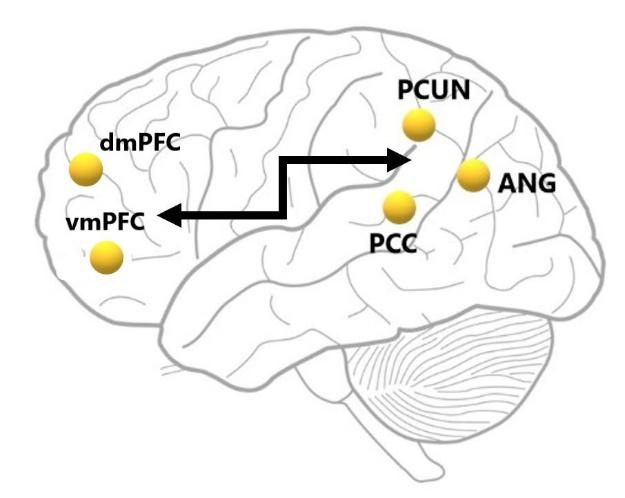
When we are not actively doing, fixing, producing, or responding, the brain shifts into what neuroscience calls the Default Mode Network (DMN). This is not a fringe idea. It is the brain’s baseline operating system, first proposed by Raichle in 2001 to refer to a constellation of areas in the brain consistently showing reduced activity when performing attention-demanding, externally oriented tasks. Since then, the DMN has become a focus of research, and it is now regarded as reflecting the brain’s intrinsic activity, including its resting state and forms of abstract cognition, such as self-referential thoughts, reminiscing, and future planning (Davey, Pujol, and Harrison, 2016; Smallwood et al., 2021). It turns on when attention drops inward, when we daydream, replay conversations, imagine futures, judge ourselves, scroll, spiral, or narrate who we are.
In other words: this is not just what we think about. This is often how we are.
And how we are is not fixed.
What the Default Mode Network Actually Does
The DMN becomes active when we are not engaged in a specific external task. It supports self-referential thought, memory recall, future planning, social evaluation, and meaning-making. This is where identity lives. This is where stories about the self get rehearsed.
When the DMN is flexible, it supports creativity, reflection, empathy, and integration. When it becomes overactive or rigid, it turns into rumination, comparison, vigilance, and obsessive self-focus.
This matters because most of modern life does not give the DMN anything to rest into. It feeds it content, stimulation, threat, and narrative but not regulation.
So the system keeps talking.
Resting State, ADHD, and Why Focus Feels So Hard
In ADHD, the DMN does not reliably deactivate when attention is required. The brain remains partially in its internal, self-referential mode while trying to engage externally. This creates constant internal noise.
Not a lack of intelligence. Not laziness. Not moral failure.
A nervous system caught between modes.
The same pattern shows up in anxiety and depression: excessive self-referencing, looping thoughts, difficulty disengaging from the past or future. The problem is not thinking. It is thinking without choice.
The Cultural Layer: Narcissism Isn’t What We Think It Is
There is a lot of talk right now about narcissism. Who is one. Who isn’t. Who is to blame. But much of what we call narcissism is actually an overactivated default mode network inside a culture that rewards self-branding, visibility, and constant identity performance.
Here’s the uncomfortable part: blaming others for narcissism is often the same DMN pattern, just projected outward.
Self-obsession doesn’t always look like confidence. Often it looks like constant comparison, outrage, self-monitoring, and moral positioning.
The work is not to eradicate the self. It’s to regulate the system that keeps narrating it.
Just own it, fam. Then work with it.
Flow Through Winter: Why This Matters Now
Flow Through Winter has been moving well. Quietly, deeply, and yes, a little edgy. Not because we are pushing, but because winter exposes how little capacity most of us have for stillness without internal demand.
Winter doesn’t ask for less activity. It asks for better regulation. Imagine if a bear was anxious about hibernating and kept waking up… the bears going to die.
Much of what we practice is not about calming down. It’s about letting the nervous system learn that it does not have to perform identity when nothing is happening.
This is where real change occurs.
And as we flow toward spring, the work of winter becomes the foundation for expansion. Spring is not a signal to accelerate blindly, it is a season for mindful growth, for letting the nervous system integrate what was learned in stillness, and for moving into direction and momentum from a place of regulated capacity. The readiness cultivated in winter allows energy to rise without overwhelm, choice to guide action without force, and the body to engage fully without losing presence. Flow into spring isn’t about doing more; it’s about doing from a steadier, more spacious nervous system.
How Does Meditation Affect The Default Mode Network?
As opposed to states of mind-wandering, meditation involves maintaining attention to the present moment, on purpose and non-judgmentally (Bishop et al., 2004). During the practice, meditators learn how to become aware of self-related thoughts, emotions, and body sensations, trying to separate the experience of these feelings from self-identifying with them.
As meditation practice ultimately results in better emotion regulation, focused attention, and a change in self-perspective, greater activation of prefrontal areas associated with executive control and self-monitoring is expected. This is what has been found in fMRI studies of experienced meditators, where a stronger coupling of prefrontal regions was observed alongside the deactivation of DMN nodes, probably due to reduced mind-wandering (Brewer et al., 2011).
Reduced DMN activity has been found across different styles of meditation, including focused attention, mantra recitation, and loving-kindness. Furthermore, fluctuations in the activation of this network seem to correlate with the degree of focus during the practice. In an fMRI study, volunteer meditators were asked to press a button every time they perceived they were distracted, and these moments were associated with greater activation of DMN areas (Hasenkamp and Barsalou, 2012).
In the longer term, meditation practice seems to result in weaker connectivity between DMN regions involved in self-referential processing and emotional appraisal, a change that can possibly be utilized for monitoring the therapeutic effects of meditation over time (Taylor et al., 2013; Simon and Engström, 2015).
The Role Of The Default Mode Network In Disorders
Alzheimer’s Disease
Alzheimer’s disease (AD) is a progressive condition primarily associated with memory loss. AD is characterized by the accumulation of amyloid-β plaques and tau tangles in regions primarily involving the medial cortical regions and hippocampus (Braak and Braak, 1991). As these regions also support DMN functionality, changes in its activity are thought to be seen in people affected by the disease. Impaired functional connectivity between the PCC and hippocampus has been detected in AD, probably reflecting hippocampal structural alterations (Sherr et al., 2021).
Studies on preceding stages of AD involving subjects with amnestic cognitive impairment (aMCI) also identified greater temporal desynchronization between the PCC and hippocampus when compared to normal aging (Mevel et al., 2011). Delayed switching between resting-state and task-related brain function has been linked to inefficient synchronization of DMN areas in both AD and aMCI (Rombouts et al., 2005).
Schizophrenia
Schizophrenia is a complex psychiatric disorder characterized by altered perception, delusions, cognitive deficits, and abnormal emotion regulation. Many fMRI studies have demonstrated altered functional connectivity of the DMN with other brain areas in people with schizophrenia, in association with both positive and negative symptoms (Hu et al., 2017). Increased functional connectivity within the DMN has also been found in patients with schizophrenia and their unaffected siblings, suggesting hyper-connectivity of intrinsic brain networks might represent an endophenotype of the illness (Liu et al., 2012).
ADHD
Clinical deficits in ADHD, including issues with attention and impulsivity, have been reported in association with delayed maturation of the DMN. ADHD studies have consistently displayed increased functional connectivity within the DMN and across the whole brain. Delays have been identified in connectivity patterns between the DMN and task-positive networks, such as the ventral attentional system and the frontoparietal network (Sripada, Kessler, and Angstadt, 2014). Abnormal functional connectivity between DMN regions and areas implicated in attentional control has also been observed in adults with ADHD, supporting the hypothesis of a maturational delay.
Depression
One of the defining features of depression is brooding rumination, characterized by a passive and recurrent focus on depressed mood and its consequences (Treynor, Gonzalez, and Nolen-Hoeksema, 2003). fMRI studies have identified areas in the DMN critically involved in ruminative processes. Specifically, the dmPFC node and its connections show activation when subjects are reflecting on their own psychological state and ruminating about past adverse events (Zhou et al., 2020). Increased connectivity has also been observed between the DMN and the subgenual prefrontal cortex (sgPFC), an area implicated in the appraisal of negative emotions and affectively laden behavioral withdrawal (Hamilton et al., 2015). Novel treatments for depression are exploring transcranial magnetic stimulation (TMS) to inhibit DMN activity and re-establish functional connectivity patterns, reducing depressive rumination (Liston et al., 2014)
Frequently Asked Questions
Is the default mode network active during sleep?
fMRI studies have shown the persistence of DMN connectivity during light sleep, reflecting the permanence of self-reflective thoughts that gradually decrease as a person falls asleep (Horovitz et al., 2009). In later stages of sleep, changes in consciousness produce a reduction in functional correlations between frontal and posterior regions of DMN regions, resulting in mPFC decoupling from the rest of the DMN. Integrated DMN activity is necessary to promote ongoing mentation and conscious awareness.
What is the role of the default mode network during creative activities?
Creativity is increasingly acknowledged as a process involving both idea generation and evaluation. During the generation phase, subjects convert conventional mental schemas into alternative ones or create multiple solutions to a problem. Activation occurs within the DMN and areas supporting novel combinations of associations, such as the insula and hippocampus (Kleinmintz, Ivancovsky, and Shamay-Tsoory, 2019). Evaluation involves executive control processes that interact with DMN activity to support working memory and facilitate switching between thinking modes (Heinonen et al., 2016).
How can the default mode network be deactivated?
Relaxation techniques, including mindfulness meditation and breathing exercises, can help reduce DMN activity, dampening self-reflective thoughts and increasing present-moment awareness (Brewer et al., 2011). Engaging in hobbies, novel activities, and social interactions can also shift thought processes, strengthen self-efficacy, and reduce passive, ruminative problem-solving tendencies (Yeshurun, Nguyen, and Hasson, 2021).
Free Monthly Update
Each month, I share one grounded reflection that orients the nervous system themes I’m working with publicly. This includes context for the season, why certain practices are emerging now, and how body-based inquiry is being shaped by culture, history, and regulation rather than productivity or performance. Subscribers also receive a preview of the paid weekly practices released on Mondays, including the focus of each piece so you can decide what kind of engagement feels supportive.
February Paid Practice Topics
(Weekly releases on Mondays. Each is a self-paced somatic practice.)
Paid 1. Feb 2
UpRegulating
A Body Practice for Restoring Capacity, Choice, and Aliveness
This practice works with the nervous system’s relationship to expansion. It explores how aliveness can feel unsafe after long periods of contraction, survival, or restraint. Rather than pushing energy upward, the practice supports the body in increasing capacity without triggering overwhelm, collapse, or self-interruption.
Paid 2. Feb 9
Lunar New Year Horse
A Body Practice for Direction, Momentum, and Regulated Drive
This practice explores forward movement without urgency. It supports clarity of direction while staying connected to pacing, breath, and internal consent. Especially useful for those who associate momentum with pressure, burnout, or loss of self-contact.
Paid 3. Feb 16
How Emotions Affect Diasporic Psychology
A Body-Based Inquiry Into Inheritance, Regulation, and Belonging
This practice explores how emotions shaped by displacement, adaptation, and cultural survival live in the body across generations. Rather than analyzing identity or story, it supports sensing how grief, vigilance, pride, and restraint function somatically and how choice can return without rejecting their purpose.
Paid 4. Feb 23
What Bruce Lee, Michael Jackson, and Michael Jordan Have in Common
A Body-Based Inquiry Into Mastery, Sensitivity, and Regulation
This practice explores mastery not as dominance or perfection, but as refined nervous system regulation. It looks at how high sensitivity, responsiveness, and precision are often misread as intensity or talent alone, when they are actually the result of deep embodied regulation and constraint management.
On the Upper Limit and Nervous System Capacity
The concept of the Upper Limit, introduced by Gay and Kathlyn Hendricks in The Big Leap, describes an internal threshold that limits how much success, joy, rest, or aliveness the nervous system feels safe holding. When this threshold is exceeded, the system often brings itself back down through anxiety, distraction, conflict, or fatigue.
From a somatic perspective, this is not a mindset problem. It is a regulation issue. Many nervous systems were trained early to associate expansion with risk, visibility, or loss of belonging. The practices this month work directly with that threshold, not by forcing growth, but by increasing the body’s ability to stay present when things are going well.
For those who want deeper support, I offer Private 1:1 Integration Sessions where these patterns are explored slowly, with consent, and in real time.
For additional reflection between sessions,
The Big Leap: Upper Limit Book – Amazon | Audible is a supportive companion text.
Closing
February isn’t asking us to push harder or perform differently. It’s asking us to notice where the mind wanders, where the body holds, and where the nervous system insists on familiar rhythms.
This is me leaning into that practice with curiosity, patience, care and istening to the body’s story rather than telling it what to do.
Thank you for being here, whether you show up in stillness, in movement, or simply witness the work from a distance. Every way of engaging is part of the process, and every moment counts.
Osiris Booque 🧬
Certified Yoga Therapist & Wellness Specialist | Osiris Yoga Therapy
📅 Book Your Complimentary Consultation Now
📘 Download Your Free Guide to Yoga for Stress Relief
💡 Stay Connected:
My Websites | Substack | Instagram | LinkedIn | Facebook ✨🐍
Now Enrolling
Flow Into Spring
An 8-week yoga therapy intensive with Osiris Booque, C-IAYT. Four live sessions exploring awareness, choice, truth, and action through Phoenix Rising methodology.
Sundays, March 22 – May 3 · 4 PM – 6 PM PST · 100% Virtual